Ramadan

Are you observing Ramadan?

Are you supporting someone observing Ramadan?

Do you know how to manage your health conditions safely and how to seek advice?

Please see this fact sheet and further information can be found:

https://britishima.org/

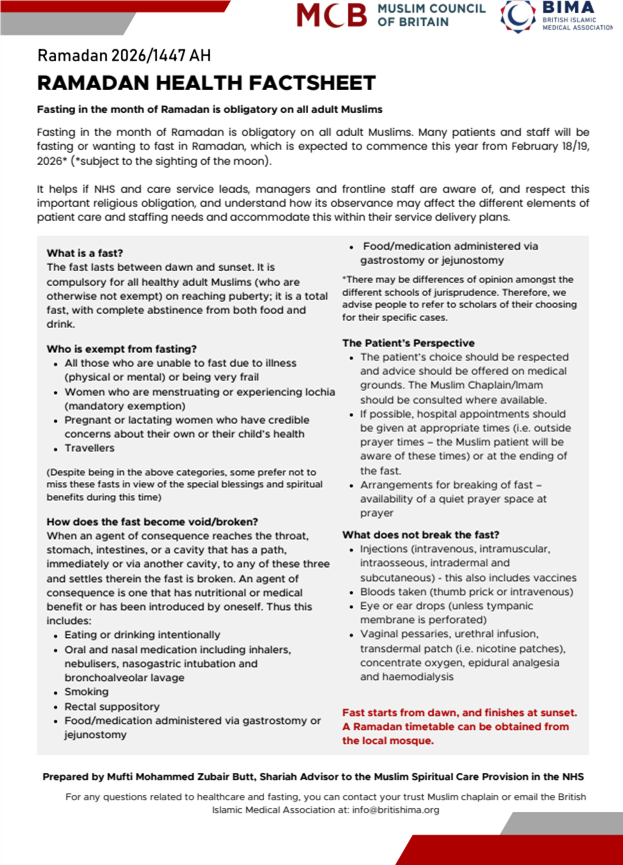
RAMADAN HEALTH FACTSHEET. Fasting in the month of Ramadan is obligatory on all adult Muslims. Fasting in the month of Ramadan is obligatory on all adult Muslims. Many patients and staff will be fasting or wanting to fast in Ramadan, which is expected to commence this year from February 18/19, 2026* (*subject to the sighting of the moon). It helps if NHS and care service leads, managers and frontline staff are aware of, and respect this important religious obligation, and understand how its observance may affect the different elements of patient care and staffing needs and accommodate this within their service delivery plans. What is a fast? The fast lasts between dawn and sunset. It is compulsory for all healthy adult Muslims (who are otherwise not exempt) on reaching puberty; it is a total fast, with complete abstinence from both food and drink. Who is exempt from fasting? All those who are unable to fast due to illness (physical or mental) or being very frail Women who are menstruating or experiencing lochia (mandatory exemption) Pregnant or lactating women who have credible concerns about their own or their child’s health Travellers (Despite being in the above categories, some prefer not to miss these fasts in view of the special blessings and spiritual benefits during this time) How does the fast become void/broken? When an agent of consequence reaches the throat, stomach, intestines, or a cavity that has a path, immediately or via another cavity, to any of these three and settles therein the fast is broken. An agent of consequence is one that has nutritional or medical benefit or has been introduced by oneself. Thus this includes: Eating or drinking intentionally Oral and nasal medication including inhalers, nebulisers, nasogastric intubation and bronchoalveolar lavage Smoking Rectal suppository Food/medication administered via gastrostomy or jejunostomyFood/medication administered via gastrostomy or jejunostomy.There may be differences of opinion amongst the different schools of jurisprudence. Therefore, we advise people to refer to scholars of their choosing for their specific cases.The Patient’s Perspective The patient’s choice should be respected and advice should be offered on medical grounds. The Muslim Chaplain/Imam should be consulted where available. If possible, hospital appointments should be given at appropriate times (i.e. outside prayer times – the Muslim patient will be aware of these times) or at the ending of the fast. Arrangements for breaking of fast – availability of a quiet prayer space at prayer What does not break the fast? Injections (intravenous, intramuscular, intraosseous, intradermal and subcutaneous) - this also includes vaccines Bloods taken (thumb prick or intravenous) Eye or ear drops (unless tympanic membrane is perforated) Vaginal pessaries, urethral infusion, transdermal patch (i.e. nicotine patches), concentrate oxygen, epidural analgesia and haemodialysis Fast starts from dawn, and finishes at sunset. A Ramadan timetable can be obtained from the local mosque. Prepared by Mufti Mohammed Zubair Butt, Shariah Advisor to the Muslim Spiritual Care Provision in the NHS For any questions related to healthcare and fasting, you can contact your trust Muslim chaplain or email the British Islamic Medical Association at: info@britishima.org.
Page last reviewed: 18 February 2026
Page created: 18 February 2026